




Tuesday, 11 August 2026 01:00 PM
Product Announcements
Vadzo Imaging's Bolt-2020CRS pairs 20MP color resolution with the Onsemi AR2020 sensor's enhanced near infrared response giving security, robotics, and industrial camera products usable color detail from bright daylight through dusk, and also supports Dynamic ROI functionality, allowing embedded vision systems to selectively capture and process important areas within the frame while reducing processing load and optimizing bandwidth utilization.
FORT WORTH, TX / ACCESS Newswire / August 11, 2026 / Vadzo Imaging, a provider of embedded vision camera products for OEMs and system integrators, today announced the Bolt-2020CRS 20MP Color MIPI Camera built on the Onsemi AR2020 sensor. The new camera module extends color imaging performance into low light and near infrared conditions that typically force a switch to a monochrome sensor or additional visible light illumination. Security integrators, robotics developers, and industrial inspection teams gain a single MIPI CSI-2 camera that holds resolution, color accuracy, and exposure stability from daylight through near dark scenes.
The Low Light Color Imaging Problem in Embedded MIPI Camera Design
Standard color image sensors lose a large share of incoming photons to the Bayer filter array that separates red, green, and blue light before it reaches each pixel. That loss becomes severe as ambient light drops toward dusk, indoor low light, or nighttime conditions common in security corridors, warehouse aisles, and outdoor inspection stations. Many embedded vision programs respond by switching to a monochrome sensor after dark, which sacrifices color information exactly when identification tasks such as license plate reading, apparel color matching, or intruder clothing description need it most. Adding supplemental visible light illumination is often not possible in covert security placements, wildlife-adjacent industrial sites, or battery-powered robotics platforms where every added watt shortens runtime.
Dynamic ROI streaming for Intelligent Image Processing:
The Bolt-2020CRS enables Dynamic ROI operation, allowing embedded vision systems to prioritize specific regions within a high-resolution image stream. Instead of processing the complete frame continuously, systems can focus computational resources on areas containing important visual information. This improves AI inference efficiency, reduces processing overhead, and enables faster decision-making in real-time applications such as autonomous robotics, industrial inspection, and smart surveillance.
How Enhanced NIR Sensitivity Extends Color Imaging into Low Light Conditions
The Onsemi AR2020 sensor at the core of the Bolt-2020CRS extends its quantum efficiency further into the near infrared band than a conventional color sensor of the same generation. Near-infrared light in the 750 to 950 nanometer range is exactly the band most industrial and security-grade infrared illuminators emit, which means the AR2020 NIR Sensor can capture usable signal from that illumination even though the human eye cannot see it. A 1.4 µm pixel and the sensor's HyperLux LP pixel design collect more of that near-infrared photon flux per pixel than smaller or older pixel architectures, giving the AR2020 Low Light Sensor a real sensitivity advantage rather than a marketing claim.
This NIR Sensitivity Camera behavior means the Bolt-2020CRS keeps functioning as a full color sensor during daylight hours and automatically gains additional signal once ambient visible light drops and NIR illumination becomes the dominant light source. Engineers describe this dual mode behavior as an Enhanced NIR Camera capability or an NIR Enhanced MIPI Camera design because no mode switch or firmware reconfiguration is required to move between lighting conditions. The result is one 20MP MIPI Color Sensor that performs the job that used to require two separate camera modules with two separate lenses and mounting designs.
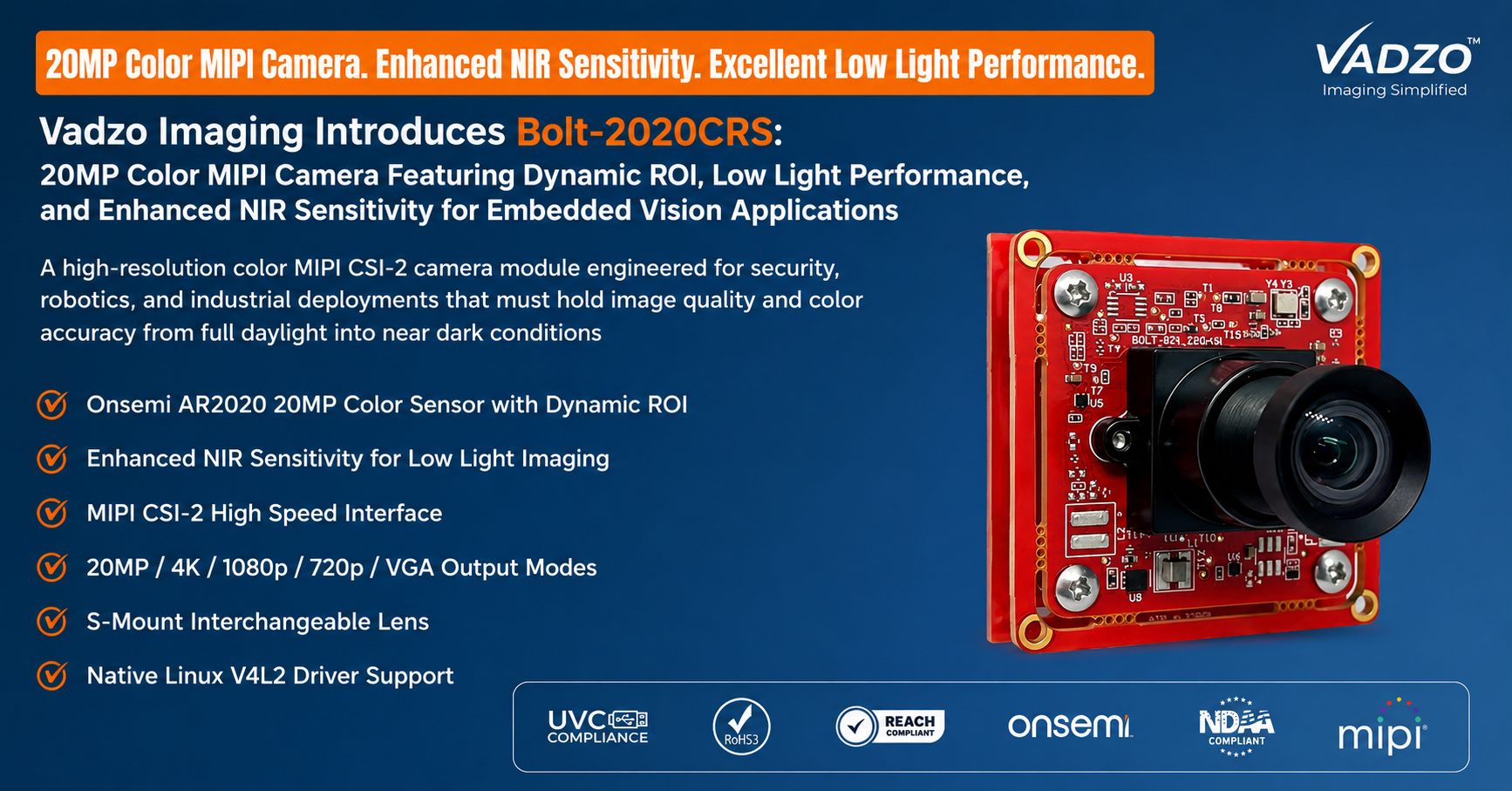
Bolt-2020CRS: 20MP Color MIPI Camera Built on the Onsemi AR2020 Sensor
Vadzo Imaging's Bolt-2020CRS is a 20MP Color MIPI Camera built around the Onsemi AR2020 sensor, delivering 5120 x 3840 resolution through a MIPI CSI-2 interface with enhanced near-infrared response built into the pixel array. The camera module ships in a compact S-Mount body with a factory-calibrated fixed-focus lens and connects directly to MIPI CSI-2 host ports on Raspberry Pi, NVIDIA Jetson, NXP i.MX8, and Rockchip platforms without a bridge board. Vadzo factory tunes auto exposure and ISP settings before shipment, so integrators receive a working module rather than a bare sensor requiring months of independent tuning.
Engineers evaluating a 20MP NIR MIPI Camera for a new security or robotics platform can move directly to the 20MP Low Light MIPI Camera listing to review pricing and request a sample. Those comparing an AR2020 MIPI Camera against other 20MP modules will find the Bolt-2020CRS product page lists an AR2020 MIPI CSI-2 Camera datasheet alongside AR2020 Dynamic ROI Camera test data captured under controlled illumination. Some engineering teams simply call it an Onsemi AR2020 MIPI Camera because the sensor generation and interface define the entire product line.
Key specs: 20MP (5120 x 3840) | Onsemi AR2020 Hyperlux LP 1/1.8 inch 1.4 µm pixel | Color | Rolling Shutter | Enhanced NIR Sensitivity | Fixed Focus | Auto Exposure | MIPI CSI-2 | 20MP / 4K / 1080p / 720p / VGA | S-Mount (M12)
Key Capabilities of the Onsemi AR2020 20MP Color MIPI CSI-2 Camera
20MP Resolution with 1.4 µm Pixels for Fine Detail in Any Light: Many 20MP class MIPI camera products trade resolution for light sensitivity by shrinking pixel size, which hurts performance the moment ambient light drops. The Onsemi AR2020 sensor in the Bolt-2020CRS captures a full 20MP (5120 x 3840) frame through a 1.4 µm pixel that keeps per-pixel light collection high even at full resolution. This 20MP Low Light Color Camera behavior lets integrators keep maximum spatial detail for license plate reads, part inspection, or facial detail capture instead of dropping to a lower resolution binned mode once the sun goes down. Engineers who need one Low Light MIPI Camera across day and night operation get it without a resolution compromise.
Enhanced NIR Sensitivity for Nighttime and Dusk Imaging: Conventional color sensors roll off sharply beyond about 700 nanometers, which leaves them nearly blind to the near infrared illumination that most security and industrial lighting systems rely on after dark. The AR2020 sensor extends usable sensitivity further into the near infrared band, so the Bolt-2020CRS functions as a 20MP NIR Color Camera that keeps producing usable image detail under NIR illuminators without switching to a monochrome-only mode. This NIR Imaging Camera behavior is especially valuable for covert security placements and industrial sites where visible illumination is impractical or undesirable.
MIPI CSI-2 High Speed Interface for Direct SoC Integration: Bridge boards and protocol converters add cost, latency, and additional points of failure to an embedded vision design. The Bolt-2020CRS is a native 20MP MIPI CSI-2 Camera that connects directly to the MIPI CSI-2 port on Raspberry Pi, NVIDIA Jetson, NXP i.MX8, and Rockchip processors using standard Linux V4L2 drivers. Engineers avoid the added bill of materials and signal integrity risk that a USB to MIPI or Ethernet to MIPI bridge introduces on a production board.
Dynamic ROI Support for Efficient Vision Processing and Bandwidth Optimization: Large-resolution imaging systems often capture more data than applications require for every frame. The Bolt-2020CRS supports a 20MP Dynamic ROI camera, enabling engineers to define and adjust specific areas of interest within the image sensor output based on application requirements. By processing only critical regions such as faces, license plates, machine components, defects, or navigation markers, embedded systems can reduce unnecessary data transfer, lower computational requirements, and improve real-time AI inference performance without sacrificing the full 20MP imaging capability when required. Dynamic ROI is especially valuable for edge AI platforms, robotics, industrial inspection, and smart surveillance applications where processing efficiency, response time, and bandwidth management directly impact system performance.
Multiple Output Resolution Modes for Flexible Bandwidth Management: A single fixed output resolution forces system designers to either oversample and waste MIPI bandwidth and processing budget or undersample and lose the detail a security or inspection task needs. The Bolt-2020CRS streams 20MP, 4K, 1080p, 720p, and VGA output modes selectable through standard sensor registers without a firmware rebuild. Engineers can run a full 20MP Dynamic ROI camera capture for forensic detail while feeding a lower resolution stream to a real-time detection model from the same sensor.
S-Mount Interchangeable Lens for Application-Specific Optics: A fixed lens locks a camera module to a single field of view and working distance, which rarely fits every deployment across a security perimeter, a robotics platform, and an industrial inspection cell. The Bolt-2020CRS uses a standard S-Mount (M12) lens holder so integrators can select wide-angle optics for perimeter coverage, narrow field lenses for long-range identification, or macro optics for close-range inspection without redesigning the camera module.
Compact Module Form Factor for Space-Constrained Embedded Designs: Drones, wearable devices, and compact robotics heads have little room to spare for imaging hardware. The Bolt-2020CRS ships as a compact board-level module with the S-Mount lens holder and MIPI CSI-2 flex connector positioned for straightforward mechanical integration into custom OEM housings without a bulky external enclosure.
"Security and robotics teams keep asking Vadzo for one camera that does not go blind after sunset. Give them a 20MP color MIPI camera that keeps working once the lights get dim and once NIR illumination takes over. The Bolt-2020CRS answers that directly. The Onsemi AR2020 sensor's enhanced near-infrared response means our customers get full color detail in daylight and usable NIR detail at night from a single MIPI CSI-2 module without carrying two camera designs through a product line."- Alwin Vincent, Product Manager at Vadzo Imaging.
Application Sections
Security and Video Surveillance: Security camera products placed at building perimeters, parking structures, and retail entrances must keep working from bright daylight through complete darkness without a hardware change. The Bolt-2020CRS functions as a Low Light Surveillance Camera that holds 20MP color detail through dusk and switches to usable NIR detail once ambient light drops further. Positioned as a Low Light Security Camera, the module reads faces, license plates, and clothing detail under NIR illuminators where a standard color sensor would return an underexposed or noisy frame.
Robotics and Autonomous Navigation: Mobile robots and AGVs operating in dimly lit warehouse aisles or overnight facility shifts lose reliable vision the moment ambient light drops below what a standard color sensor needs. A Low Light Robotics Camera built around the Bolt-2020CRS keeps delivering usable color and NIR detail for obstacle detection and marker recognition regardless of shift schedule or aisle lighting. With Dynamic ROI support, the Bolt-2020CRS enables robotics systems to prioritize and process critical areas within the image frame, such as obstacles, navigation markers, and moving objects, while reducing unnecessary image data processing. This helps edge AI platforms improve inference speed, optimize bandwidth usage, and deliver faster real-time navigation decisions without continuously processing the entire 20MP image stream. Robotics teams are standardizing on a single sensor generation across day and night shifts to avoid maintaining two separate camera configurations for the same platform.
Industrial Inspection and Machine Vision: Inline inspection stations positioned near loading docks, unlit mezzanines, or enclosed machine housings frequently operate with minimal ambient light. A Night Vision Inspection Camera configuration of the Bolt-2020CRS holds part identification accuracy under NIR illumination where a standard color inspection camera would need supplemental visible lighting that risks disturbing nearby operators. Deployed as a Low Light Industrial Camera on multi-shift production lines, the module maintains the same detection thresholds across day shift and night shift without recalibrating exposure settings. With Dynamic Region of Interest (Dynamic ROI) capability, the Bolt-2020CRS allows machine vision systems to focus processing resources on specific inspection areas, such as component surfaces, defect zones, or critical measurement regions, instead of continuously analyzing the complete image frame. This helps reduce processing overhead, optimize bandwidth usage, and improve real-time defect detection performance in high-resolution industrial inspection workflows. Machine vision integrators describing the same behavior as an NIR Machine Vision Camera capability appreciate that color classification tasks keep working under the same NIR illuminators used for defect detection.
Traffic Monitoring and Smart City Deployments: Traffic monitoring systems must read license plates and vehicle details at every hour of the day, including the hours when headlight glare and near darkness dominate the scene. The Bolt-2020CRS operates as a Night Vision MIPI Camera that pairs 20MP resolution with NIR sensitivity to keep plate characters legible under roadway NIR illuminators. Dynamic ROI enables smart traffic systems to selectively process important regions such as license plates, vehicle lanes, traffic signals, and incident areas while reducing unnecessary image data processing. This improves real-time analytics performance, lowers edge computing requirements, and helps AI-based traffic monitoring systems respond faster while maintaining the advantage of high-resolution image capture. Smart city integrators combining daytime color classification with nighttime NIR detection get both from the same sensor rather than deploying separate day and night camera models at each intersection.
UAV, Drone, and Embedded Edge AI Platforms: Aerial inspection and mapping platforms often fly missions that start in daylight and continue into dusk, which leaves standard color payload camera products struggling for the final portion of a flight. An Embedded NIR MIPI Camera payload built on the Bolt-2020CRS keeps returning usable imagery as ambient light fades because the AR2020 sensor's enhanced NIR response extends the useful shooting window. OEM teams building an OEM NIR Camera Module program around this sensor for drones, perimeter robots, or portable inspection tools get the same NIR Enhanced Vision Camera performance across every unit without adding a second illuminated sensor to the payload.
Frequently Asked Questions
Q: How does enhanced NIR sensitivity in a color MIPI camera improve nighttime detection compared to a standard visible light sensor?
A: A standard color sensor loses most of its sensitivity beyond the visible spectrum because its color filter array is tuned for red, green, and blue light rather than near-infrared light. A sensor with enhanced NIR sensitivity keeps collecting usable signals from near-infrared illuminators that operate outside the human visual range, which is exactly the light source most security and industrial systems switch to after dark. Vadzo Imaging designs its 20MP color MIPI camera products around this extended sensitivity, so integrators get one sensor that performs through the full transition from daylight into near-infrared-illuminated darkness rather than two separate camera designs for day and night operation.
Q: What is the practical difference between a low light color sensor and a dedicated monochrome NIR sensor for security applications?
A: A dedicated monochrome sensor removes the color filter array entirely, which maximizes low light sensitivity but gives up color information at every hour of the day, including bright daylight when color detail matters most for identification tasks. A low-light color sensor keeps the color filter array while extending sensitivity further into the near-infrared band, so it delivers full color imaging during the day and still produces usable detail once NIR illumination takes over at night. Vadzo Imaging recommends a low-light color sensor for any security or industrial deployment that needs color classification during daylight hours alongside dependable nighttime coverage from the same camera module.
Q: Can a high-resolution color MIPI camera keep accurate color reproduction in dim indoor lighting without adding extra illumination?
A: Yes. The achievable improvement still depends on how much ambient light is actually present in the scene. A sensor with high per-pixel light collection and enhanced near-infrared response pulls in more usable signal from dim indoor lighting than a smaller pixel sensor would, which keeps color noise lower and exposure more stable without requiring a supplemental light source. Vadzo Imaging validates its 20MP color MIPI camera lineup under a range of dim indoor and outdoor lighting conditions, so integrators know the achievable performance envelope before committing to a lighting design for their deployment.
Q: Does enhanced NIR sensitivity require a special infrared illuminator to work effectively at night?
A: Enhanced NIR sensitivity by itself only improves how much of the near-infrared light already present in a scene the sensor can capture. It does not generate its own illumination, so a scene with zero infrared light present will still appear dark regardless of sensor sensitivity. Most security and industrial deployments already use near-infrared illuminators for covert or supplemental night lighting, and an enhanced NIR sensor simply makes far better use of that existing illumination than a standard color sensor would. Vadzo Imaging's applications engineering team helps OEM customers match illuminator wavelength and power to the sensor's NIR response curve during system design.
Q: Why does Vadzo Imaging highlight enhanced NIR sensitivity as a core feature of its 20MP color MIPI camera lineup rather than offering a separate day camera and night camera?
A: Maintaining two separate camera designs for day and night operation doubles the mechanical integration work, the driver validation effort, and the spare parts list an OEM program has to support. Vadzo Imaging builds enhanced NIR sensitivity into its 20MP color MIPI camera lineup, so a single sensor, a single lens mount, and a single driver stack cover full daylight color performance and nighttime NIR performance without a hardware swap. This approach shortens qualification time for OEM programs and gives system integrators one part number to stock instead of two for any deployment that must operate around the clock.
Availability
The Bolt-2020CRS 20MP Color MIPI Camera built on the Onsemi AR2020 sensor is available now for evaluation and production orders. Evaluation kits include the camera module, an S-Mount fixed focus lens, a MIPI CSI-2 flex cable, and platform driver documentation with no minimum order requirement. Engineers comparing this MIPI Camera Low Light Module against other 20MP options can browse the full Vadzo camera portfolio at https://www.vadzoimaging.com/ or contact Vadzo at [email protected] to request an evaluation kit or discuss OEM integration requirements.
About Vadzo Imaging
Vadzo Imaging is a global provider of embedded vision camera products serving OEMs and system integrators in robotics, industrial automation, unmanned aerial systems, edge AI, and security markets. Vadzo designs every camera module for straightforward integration with leading embedded computing platforms and backs its products with hardware customization, firmware development, and module-level driver support that shortens the path from evaluation to production deployment.
Media Contact
Alwin Vincent
Vadzo Imaging
Email: [email protected]
LinkedIn: Vadzo Imaging
YouTube: Vadzo Imaging
X: Vadzo Imaging
SOURCE: Vadzo Imaging